

At Tairangi School in Porirua, a collaborative project is weaving together pūrākau, place-based learning and digital education. This, the last of three articles, showcases the impact of the project on the school. It also looks at how mahi in the classroom has inspired and informed the learning specialists at Nōku te Ao to design and trial learning programmes that promote digital storytelling.
Since the start of the year, Tairangi School tumuaki Jason Ataera, kaiako and ākonga haveworked with Dr Andrea Milligan and her team of learning specialists at Nōku te Ao Capital E in Wellington; Rochelle Thorn, tumuaki at Te Kura o Hanana; and Dr Ben Egerton and Kelly Te Paa from Te Herenga Waka–Victoria University of Wellington.
Together, they explored how digital learning might empower ākonga to show and share their stories, with particular interest in cultural storytelling and stories of place.
Ākonga mahi at Tairangi School
From the start of the year, classroom teaching and learning programmes at Tairangi School linked to an overarching schoolwide theme of ‘ko wai au?’
Students wrote autobiographical pieces focusing on themselves, friends and whānau, or creating artwork in which they, in various ways, see themselves reflected.
While this theme continued into terms 3 and 4, it broadened and deepened. The focus in the first half of the year was on ‘who am I?’ Classroom conversations and thinking have developed into such questions as ‘where have I come from?’ which, in turn, have prompted whānau stories and stories about place.
Kaiako encouraged ākonga to ask whānau for stories they have not heard before,
strengthening home-school partnerships. At school, they’ve been learning about pūrākau from their rohe. Not only is this broadening ākonga conceptual understanding of ‘ko wai au?’, but it’s allowed kaiako to expand how the theme permeates teaching and learning.
Jason led one staff meeting at the start of term 3 where he encouraged his kaiako to consider how ‘ko wai au?’ might be explored through text selection in literacy lessons. He asked how, having experienced digital possibilities at the school’s Excite Day, ākonga might be given opportunities to create with those new tools.
Nōku te Ao learning design
The education specialists from Nōku te Ao were able to lend a listening ear to these
classroom experiences. Chelsea and Finn used insights from ākonga and kaiako to inform learning programme design at Nōku te Ao.
It is not Chelsea and Finn’s intent to design some of Nōku te Ao’s programming around the specifics of what Tairangi School kaiako and ākonga talked about. Rather, they will try to capture ākonga inquisitiveness and understanding of self, and the valuing of place-based cultural stories ākonga have shared.
And then, like Chelsea and Finn demonstrated at Tairangi School’s Excite Day in the middle of the year, the question is one that ākonga from around Pōneke and beyond can ask:
“What happens when we show and share our stories through digital technologies?”
Elements of the learning design
Having worked closely with ākonga and kaiako for the year, and having taken on board their input, Chelsea and Finn understood that learning design at Nōku te Ao needed to allow for several things:
- Any learning at Nōku te Ao needed to complement what was already happening in the classroom.
- The story or stories ākonga were showing and sharing needed to be familiar to them.
- In using digital tools, ākonga needed to be able to be up and running as quickly as possible.
- There needed to be a tangible output at the end of the session for ākonga to share or interact with.
Testing time!
Tairangi’s involvement isn’t over – far from it!
Not only were ākonga originators of the learning and story sharing, and their whakaaro contributed to Nōku te Ao learning designs, they were invited to come and test them out.
In October and early November, tamariki and their kaiako bussed into central Wellington to spend a day at Nōku te Ao and e Waka Huia o Ngā Taonga Tuku Iho Wellington Museum.
On the first day all the senior classes came, and the juniors came on the second visit.
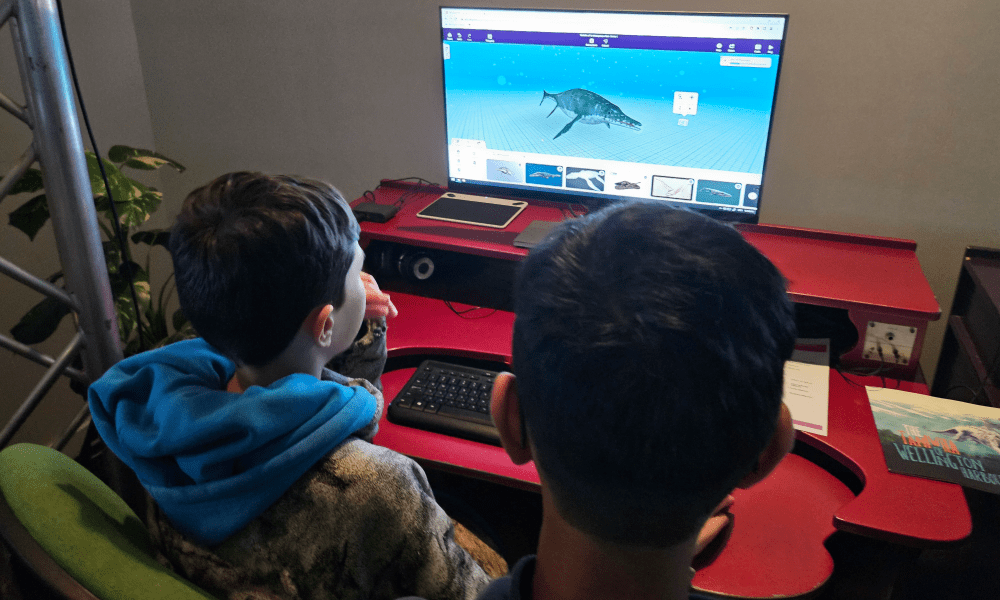
Based on the story of Ngake and Whātaitai – a story familiar to ākonga from the class – Chelsea and Finn designed two learning experiences they were keen for Tairangi tamariki to test. The first experience used new software called Delightex and simple coding processes to let ākonga share a scene from the pūrākau in 3D.
This was adapted for the junior ākonga to use tablets rather than PCs. The second experience, designed specifically for the young audience, had students using a green screen and puppet taniwha to film the scene.
Tamariki from Tairangi were delighted to have a go at using digital tools to tell their own versions of Ngake and Whātaitai. Asked what they liked about digital storytelling, one student replied, “everything!”
“We got to spend a lot of time on our story,” says another student in Year 2. “It was fun to make our version,” adds a fellow Year 2 ākonga.
One of their teachers, Kylie, commented on how important it was that “students had had the opportunity to work on the story in the classroom prior to coming into Nōku te Ao”. This backgrounding allowed ākonga to get straight into the digital element.
Viv, another teacher with the rōpū, liked how the students were able to “get on with things and be inspired to create, even if they needed help with the technology”.
She admits some of her students found it hard to concentrate. Feedback like this is vital for the Nōku te Ao team. It can only make for more effective, more powerful learning, especially for younger tamariki.
The next stage
The project team are excited to involve a second kura in 2026: Shannon School ,Te Kura o Hanana. Tumuaki Rochelle Thorn has actually been part of the project from the start, having done consultation mahi with Wheako Pōneke Experience Wellington and worked with Andrea, Jason and Ben in the first half of 2025.
Ben, the project’s principal researcher, says, “the team and I are excited to see which stories emerge from building new kaupapa with another school in a different rohe”.
The location, history and iwi affiliation of Te Kura o Hanana mean different pūrākau and perhaps new ways teaching and learning.
Ben says he “can’t wait to see the ways in which these stories will travel”.
Rochelle is pleased her tamariki, kaiako and community are involved.
“As a kura we are wanting to further develop and deepen our place-based localised curriculum. We’re excited to work alongside the Nōku te Ao team in 2026 to do this.
This partnership will provide our teaching teams with access to skill sets and resources we’d otherwise be unable to access, in the process broadening the educational and learning experiences of our tamariki.”
Andrea and her team at Nōku te Ao are keen to continue working with Tairangi, and also to partner with a school further out.
“We know that shared planning between educators and teachers is important to set ākonga up for success. Each time we work with kaiako to meet the needs of their ākonga we learn more about how to integrate digital learning experiences inside and outside the classroom.”
By working with Tairangi and Shannon Schools, the project team anticipate more findings with which they can design digital learning at Nōku to Ao. They also hope to start developing and sharing ideas that schools across the motu might adopt, adapt, or enact.
Ngā mihi nui ki a koutou
While there’s still more mahi to be done, and more investigating to take place, one thing everyone can be delighted with is the sense of genuine partnership underpinning the project to date.
The project leaders wish to thank all those involved for their mahi, participation and input, especially tamariki and kaiako at Tairangi School. We’re all looking forward to next year!
Part three of Pūrākau, place and digital learning: Storytelling in action. Read part 1 here and part 2 here