

Since the start of the year, through the schoolwide Ko wai au? learning theme, students at Tairangi School in Porirua have been encouraged to think, “What can I tell you about myself?”
This is opening up all sorts of possibilities for tauira to share many different stories about themselves, their whānau, where they come from and where they are now.
And Tairangi School staff, tumuaki at Te Kura o Hanana, education specialists at Nōku te Ao Capital E in Wellington, and researchers from Te Herenga Waka Victoria University of Wellington have deepened their own understanding of how digital tools support pūrākau (storytelling).
In addition to exploring how developing stories feeds into the school’s literacy goals, kaiako involved in the project collectively arrived at a rationale for emphasising story, and for explaining this learning to their ākonga, says Tairangi School tumuaki Jason Ataera.
“Stories are ways to express ourselves, share experiences, memories and journeys. They can be relational and can challenge your own or others’ point of view of yourself and the world. Stories invite you to share.”
Excite Day
To support storytelling and to expose tauira to digital tools to share Ko wai au? Tairangi School kaiako put on Excite Day in early August.
Leading up to Excite Day, kaiako invested a considerable amount of time and effort over term 2 to research and familiarise themselves with a digital platform, app, or digital tool they believed would support students to tell stories. Kaiako helped one another find tools, act as critical friends over a tool’s effectiveness, and drew on the expertise of Chelsea Wynne and Finn Culver, Nōku te Ao’s education specialists.
The plan for Excite Day was simple. Tauira across the school were put in rōpū of about 12 – staying with their year groups – and rotated through ‘taster sessions’ that introduced a digital tool or platform. For each session, kaiako introduced the tool, students had a go at creating something using the digital tool and the session concluded with a teacher-directed short plenary. All this happened in half an hour.
Digital taster sessions boost confidence and fun
Across Tairangi School, teachers offered students taster sessions on a number of apps, tools and platforms. For most activities, students worked in pairs, unless otherwise noted.
Scratch – Years 1–3 students created characters and coded them to move through story backgrounds.
Bee-Bots – Years 1–3 students guided their bots around obstacles.
Stop Motion Studio – students created short stop motion animations in a range of teacher-designed sets (beach, playground, zoo, city, and so on).
Chatterpix – Years 1–3 students took photos of an object and recorded it talking.
Sock Puppets – Years 1–3 virtual sock puppets that students designed and voiced.
Green Screening – individually, all students dressed up and superimposed themselves on a background.
Holograms – all students created a Perspex lens to turn a video image into a 3D-effect
hologram.
Polycam Pro – Years 4–8 students created a 3D photograph of a physical object.
Book Creator – Years 4–8 students wrote, produced and shared a story using a range of customisable templates.
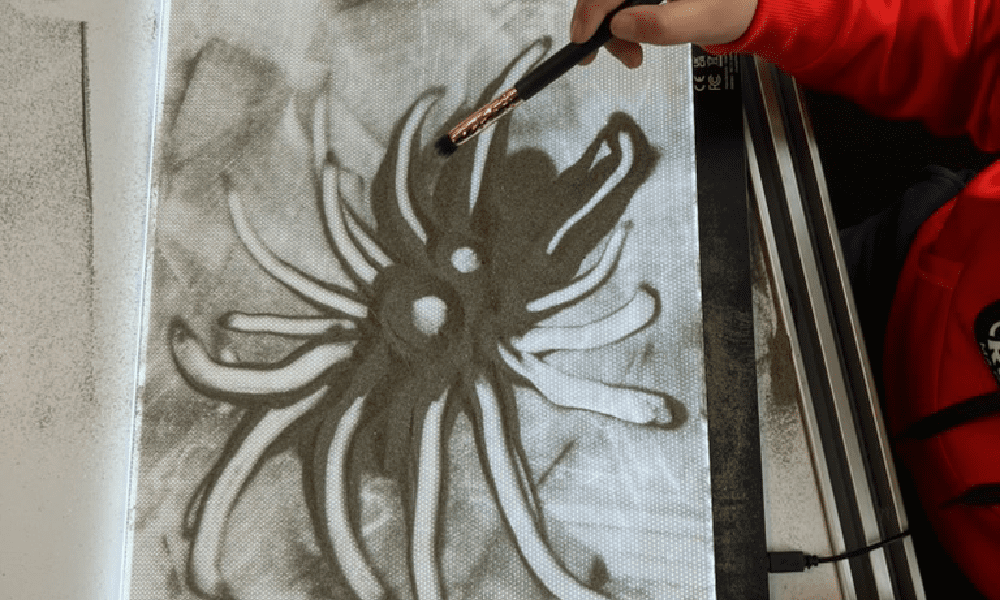
Light Frames – all students created sand pictures on a light box or light frame.
Construct – Years 4–8 students created and played their own video games.
Students loved it. And the sense of confidence they (and the teachers) got from this was clear.
“Everyone had fun” said one of the Year 3 ākonga. And, with delight, another talked about the stop motion activity and how “we were able to let our imaginations run wild”.
How could I use this to tell a story?
At the end of each half-hour rotation, before tauira moved onto the next activity, kaiako asked them to reflect on the digital tool they’d just used.
Jason had prepared a poster with a reflective question, used for all rōpū after each activity:
“How could I use this to tell a story?”
Kaiako guided tauira to consider this question in different ways. For example, Karen – who’d been guiding students to design characters and backgrounds in Scratch – surfaced student whakaaro around the story components of characters, setting and plot. Olive, who’d been working with tauira to programme Bee-Bots, unpacked student-think about how you can tell a story through collaboration. And as Olive reported back, “Students …developed cooperative skills and rich conversation.”
Suskya and Jeanne, however, took a different approach again with tauira who came to their activities – the Sock Puppets app and using a lightbox for sand art respectively. Both kaiako drew out thoughts about what kinds of story students might tell through their tools.
Others, including Jason, suggested what the stories might be about: “We could make a story about our families and tell stories about places, like Taranaki.”
Where individual teachers were taking their conversations wasn’t pre-planned. Each focus on an aspect of storytelling arose organically, partially because of how each tool lent itself to emphasise an aspect of storytelling, and partly because of how each teacher facilitated a conversation.
Each activity provided accidental sequencing and progressions of learning. For example, Bee-Bots, with their computational thinking emphasis on programming and direction, followed on from Scratch – a tool designed to develop computational thinking and programming; or telling stories through still images on a light box transitioned into stop motion animation – a process of animating through a sequence of still images.
How ākonga told their stories
Back in their classes, kaiako gathered tauira feedback on Excite Day. Kaiako were interested in how engaged ākonga were in the activities – including accessibility, ease of use and how quickly they could be up and running on the tool – but they were also interested in how ākonga made links for themselves between the tool and its application in the storytelling process.
“We can make characters and make them move,” said one student about the Scratch activity new entrant teacher Karen had organised.
“We can make ourselves look like we’re flying or swimming,” said another about using the green screen.
“We can make a story about our families,” noted a student after using the Sock Puppets app.
All learner feedback from across the school was aggregated by Jason and – with a little help from AI – he sorted it into themes.
These were broad ways in which digital tools can help ākonga tell stories:
- Creating characters and settings.
- Using voice, sound and dialogue.
- Making stories move.
- Personal and social storytelling.
- Collaboration and co-construction.
- Ease of use.
But what do we mean by ‘story’?
In all this emphasis on digital tools, the learning specialists from Nōku te Ao realised they’d taken the understandings of ‘story’ for granted. But it seemed that, in student feedback, they had an implicit understanding. Viv reminded her colleagues that students understood “how stop motion is perfect for showing a story that evolves”.
This was also in evidence from interactions with students as they were engaging in Excite Day.
Researcher from Victoria University of Wellington Ben, sitting alongside a Year 4 student, asked him what he was doing with his sand on the light tray.
“I want to draw a man with ta moko”, the student replied. He explained that ta moko tells a story.
Other activities – such as 3D photographs of taonga – give students ways into conveying story beyond a linear action progression of ‘problem, solution and resolution’.
And this is where the final phase of the project will take tauira and kaiako and – crucially – whānau and community to. Māori whānau are already being engaged and consulted about the Ko wai au? learning programme, with a view to presenting during Te Wiki o te Reo Māori in September. Moves are already underway to further surface stories from the community through whānau engagement, special assemblies and drawing on iwi initiatives. Kaiako too, in staff hui, have been exploring what they understand by ‘story’, from which emerged:
“Stories are a vehicle for identity. They help students share who they are, where they come from, and what they value.”
“[Stories] connect personal reflection with oral language practice (and they align with ‘talk moves’ in DMIC).”
“[Stories] provide a safe platform for learners to express their voice, beliefs and unique perspectives.”
Bringing story and digital technology together
A question Jason asked is also guiding this next phase: “How do stories travel?” How does a story go from one place to another, and convey that understanding of ‘place’?
Kaiako have already asked tauira how digital tools can be used to tell a story. Now, the question will be expanded: “How can the same tools be used to share that story?”
“Here’s where digital technology and stories will come together. As we plan for the final phase, not only will more stories surface from the wider Tairangi community, and not only will we expand our understanding of what ‘story’ is, but we’ll want to encourage those stories to travel.”
Part two of Pūrākau, place and digital learning: Storytelling in action. Read part 1 here.